What drives a military to seize power, burn villages, consult astrologers before battle, and keep fighting even as it loses ground? The answer lies deep in history and in the mind of an institution.
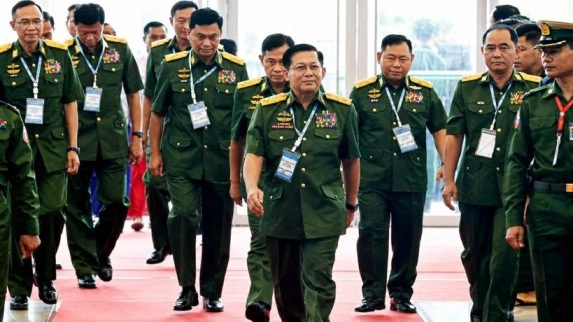
There is an old Burmese proverb that says a country without a strong centre will fall apart like a bundle of sticks with a broken cord. For over six decades, Myanmar’s military, known as “The Tatmadaw”, has used this logic precisely to justify its grip on the nation. It is not just an army. It is, in the fullest sense, a state within a state: a vast political, economic, and ideological institution that controls courts, companies, hospitals, schools, and, most importantly, the narrative of what Myanmar is and who gets to define it.
Since the February 2021 coup that overthrew Aung San Suu Kyi’s elected government, the Tatmadaw has once again placed itself at the centre of Myanmar’s story. But it is struggling. Ethnic armed organisations (EAO) and the newly formed People’s Defence Forces (PDF) have inflicted significant losses that would have been unthinkable a decade ago. Entire frontier states have slipped from junta control. Senior officers have been killed. And yet, the military presses on with the same tools it has always used: fire, fear, and the iron conviction that it alone can hold the country together.
To understand why, you have to go back to the beginning. You have to understand not just what the Tatmadaw does, but what it believes.
Born in Fire: The Siege Mentality That Never Left
The Tatmadaw was born in extraordinary circumstances. Founded in 1942 under the Japanese occupation by General Aung San, the father of Aung San Suu Kyi, and the founding hero of independent Myanmar, it was never simply a professional military in the conventional sense. It was a liberation army, a nationalist vanguard, a political movement in uniform. From its very first days, its identity was inseparable from the idea of the nation itself.
Independence from Britain in 1948 brought not peace but an almost immediate unravelling. Within months, Burma faced a Communist Party insurgency, mutinies from within its own ranks, and rebellions from Karen, Mon, and other ethnic armies. Then, to make things dramatically worse, Kuomintang Chinese Nationalist forces (KMT), fleeing Mao’s revolution, crossed into Burma’s Shan State and began using it as a base of operations, bringing the Cold War right onto Burmese soil. A country that had barely drawn its first breath of independence was suddenly fighting on half a dozen fronts at once. Put simply: Myanmar’s military was born into chaos, and it never forgot that feeling.
This is where the siege mentality, the psychological bedrock of everything the Tatmadaw does, was forged. The young officers of that era drew a lesson from those years that has been handed down through generations like scripture: Burma is fragile. Its ethnic diversity, its geography, and its position between great powers all make it perpetually vulnerable to disintegration. And if the centre does not hold with an iron fist, it will not hold at all.
This is not merely a convenient excuse, though it has certainly been used as one. It is a genuinely held belief. The Tatmadaw’s worldview is rooted in authentic trauma, the trauma of a state that almost ceased to exist in its infancy. The problem, of course, is that institutions which survive on fear tend to keep manufacturing it, even when the actual threat has changed.
The Doctrine of Total Control: Four Cuts and the Machinery of War
By the 1960s, the Tatmadaw had developed the intellectual tools to match its instincts. Two doctrines in particular define its operational soul, and both are worth examining closely.
The first is Pya Ley Pya, “Four Cuts.” Developed in the 1960s by General Tin Oo (later purged, but his doctrine lived on), the strategy was designed to defeat ethnic insurgencies by cutting off their four lifelines: food, funds, intelligence, and recruits. The logic is elegant in its ruthlessness. An armed group that cannot feed itself, finance itself, gather information, or replenish its fighters will wither. The problem is that in practice, “cutting” these lifelines meant targeting the civilian communities that sustained them, burning rice stores, forcibly relocating villages, and terrorising populations into non-cooperation.
What this means, in human terms, is that the Four Cuts strategy institutionalised collective punishment. It made civilian suffering not a regrettable side effect of war but a deliberate instrument of it. Generations of Tatmadaw officers were trained in this framework. It became normal. The scorched villages in Rakhine, Chin, Kayah, and Sagaing states that we see on satellite imagery today are not aberrations; they are the Four Cuts in their twenty-first-century form, updated for drone warfare and social media but philosophically unchanged.
The second doctrine, less well known but equally revealing, is the concept of Sit Tat Thamada, sometimes translated loosely as “Total People’s War.” Borrowed partly from Maoist counter-insurgency theory and partly from the Tatmadaw’s own experience, this doctrine envisioned the entire population as a potential resource in the defence of the state. Communities were to be mobilised, monitored, and, if necessary, coerced into supporting the military’s objectives. The line between soldier and civilian, protector and suspect, was made deliberately blurry.
Together, these doctrines reveal a military that does not distinguish cleanly between the population it claims to protect and the battlefield it fights on. Civilians are either assets or threats. There is no neutral ground.
Guardians of Race and Religion: The Ideology That Justifies Everything
Doctrine alone, however, does not explain the Tatmadaw’s longevity or its internal cohesion. For that, you need to understand its ideology, and specifically, its self-appointed role as the guardian of what it calls the “Three Main National Causes”:
- The Non-Disintegration of the Union
- The Non-Disintegration of National Solidarity
- The Perpetuation of Sovereignty
These phrases sound abstract. In practice, they mean something very specific: the Tatmadaw, and the Tatmadaw alone, is the legitimate custodian of Myanmar’s national identity. Everyone else, politicians, activists, monks, journalists, ethnic leaders, is a temporary actor on a stage that the military ultimately controls.
This ideology has a racial and religious dimension that gives it particular potency. The dominant narrative within the Tatmadaw frames the Bamar majority and Theravada Buddhism as the authentic core of Myanmar’s identity. Ethnic and religious minorities- particularly the Muslim Rohingya, but also Christians in Chin and Kachin states- are implicitly or explicitly framed as threats to this core identity. They are, in the Tatmadaw’s worldview, not fully Burmese.
This is how a military can carry out what the United Nations has described as genocide- as happened in Rakhine State in 2016 and 2017, when 700,000+ Rohingya fled to Bangladesh following a campaign of mass killing, rape, and arson- and frame it internally as a security operation. The logic is not cynical, at least not entirely. Many within the Tatmadaw genuinely believe they were defending the nation. That is, in some ways, more frightening than cynicism.
The political dimension of this ideology was on full display in the 1962 coup, when General Ne Win seized power from an elected government, and again in 1988, when the military crushed a pro-democracy uprising with extraordinary violence, and yet again in 2021. Each time, the justification was the same: civilian politicians were allowing the country to slide toward chaos, and only the Tatmadaw could save it. The coup is not a disruption of the natural order, in the Tatmadaw’s telling. It is the natural order. Democracy is a temporary indulgence.
Fear as a Weapon: Brutality, Psychology, and the Business of Terror
Ask any researcher who has spent time with survivors of Tatmadaw operations, and they will tell you the same thing: the violence is rarely random. It is strategic. It is designed to be remembered, talked about, and feared.
This is a military that has historically understood the psychological dimension of warfare with grim sophistication. The burning of villages is not just about destroying shelter; it is about creating refugees who spread fear into the next village. The public execution of resistance sympathisers is not just punishment; it is a demonstration of reach and impunity. The rape of women during military operations has been documented by investigators as a systematic tool for humiliating and demoralising communities.
The Tatmadaw’s strategic culture treats terror not as a failure of discipline but as a method. This is not unique to Myanmar; many militaries have used terror as a weapon, but in the Tatmadaw’s case, it has been so consistent, across so many decades and so many different conflicts, that it clearly reflects an institutional logic rather than individual pathology.
“Divide and rule” completes the picture. One of the Tatmadaw’s most effective long-term strategies has been to fracture ethnic alliances by recruiting fighters from one community to fight against another- arming the Rakhine against the Rohingya, for instance, or using Pa-O militias against Shan insurgents. The goal is not to defeat all enemies simultaneously but to ensure they never unite against a common foe. A Myanmar in which everyone distrusts everyone else is, from the Tatmadaw’s perspective, a Myanmar that needs the military to hold it together.
It is a self-fulfilling prophecy, and a brilliantly cynical one.
Stars, Spirits, and Strategy: The Mystical Dimension
Here is where the Tatmadaw’s strategic culture becomes truly singular, and where foreign analysts, especially those trained in Western military theory, tend to get lost.
The role of astrology, numerology, and Buddhist ritual in Tatmadaw decision-making is not a footnote. It is a central feature of how the institution operates at its highest levels.
General Ne Win, who ruled Burma from 1962 to 1988, is the most documented example. He was deeply influenced by personal astrologers and numerologists. His decision in 1987 to demonetise the currency and replace it with denominations divisible by nine, a number he believed to be lucky, wiped out the savings of millions of ordinary Burmese overnight, contributing directly to the 1988 uprising that nearly toppled his regime. The choice was not economic. It was mystical. Than Shwe, who led the Tatmadaw junta from 1992 to 2011, moved the entire capital city from Yangon to the newly built Naypyidaw in 2005, a decision taken, according to multiple credible accounts, on the advice of an astrologer who warned him that a disaster was coming to Yangon. The move was sudden, poorly planned, and economically irrational. But it happened because the general believed it was necessary for his personal protection.
Even today, the use of protective amulets among soldiers is widespread. Tatmadaw troops reportedly wear yadaya charms, objects believed to confer invulnerability, and recitations of Pali Buddhist scripture are performed before operations. Senior officers consult court astrologers on auspicious dates for military campaigns. The 2021 coup itself, launched at the peculiar hour of 3:00 a.m. on February 1st, was timed in part, analysts believe, to align with numerological considerations.
What does this tell us? It tells us that the Tatmadaw is not purely a rational actor in the way that Western strategic theory assumes. Its decisions are shaped not just by political calculation or military logic but by a belief system in which the spiritual and the material are deeply intertwined. This does not make it less dangerous; it may, in some ways, make it more unpredictable. A general who believes he is protected by the stars may take risks that a purely rational actor would not.
A Culture Under Stress: When the Playbook Stops Working
For the first time in its history, the Tatmadaw is facing a challenge that its strategic culture is genuinely ill-equipped to handle.
The resistance movement that emerged after the 2021 coup is unlike anything Myanmar’s military has faced before. It is not a single ethnic army with a fixed territory and a political leadership that the Tatmadaw can negotiate with or manipulate. It is a distributed, decentralised, ideologically motivated network of People’s Defence Forces, coordinating loosely with veteran ethnic armies and drawing on a generation of young people who have grown up with smartphones, social media, and a very different understanding of who they are and what they owe the state.
The Tatmadaw’s instinctive response has been to do what it has always done: escalate brutality, burn more villages, deploy more airstrikes. In 2023 and 2024, the military carried out some of the most intense aerial bombardments of civilian areas in Myanmar’s history. Cities, markets, hospitals, and schools in Sagaing, Chin, Kayah, and Rakhine states were struck from the air. The logic was familiar: make the cost of resistance so high that populations will withdraw their support.
But something different is happening this time. The resistance is not withdrawing. It is adapting. Operation 1027, launched in October 2023 by a coalition of ethnic armed organisations and People’s Defence Forces in northern Shan State, swept away Tatmadaw positions across hundreds of miles of territory with a speed that stunned outside observers. The military’s response, scapegoating commanders, denying losses, and continuing airstrikes on civilian areas, revealed an institution that had no new ideas. Its top-down, fear-based command culture, which punishes initiative and rewards obedience, is a severe liability against an enemy that is precisely the opposite: bottom-up, adaptive, and motivated by genuine popular anger.
There are reports of serious morale problems within Tatmadaw ranks. Forced conscription, introduced in February 2024, suggests that voluntary recruitment has collapsed. Officers are reportedly reluctant to be posted to frontline positions. Defections, while not yet a flood, are occurring. The institution that built its entire identity around being the indispensable guardian of Myanmar is struggling to perform the most basic military function: holding ground.
And yet, this is crucial; there is no sign that the strategic culture itself is changing. Brutality continues. The ideological narrative continues. The astrologers continue to be consulted. An institution whose entire identity is built around the idea that it cannot be wrong, that its setbacks are caused by enemies and traitors rather than its own failures, is structurally unable to learn in the way that adaptation requires.
The Long Shadow: Where This Ends
The Tatmadaw’s strategic culture is, at its core, a closed loop. It was born from fear of disintegration, and it produces conditions, ethnic conflict, political repression, and economic failure that generate more disintegration, which in turn justifies more military control. It is a cycle that has been running for over seventy years, and it has consumed generations.
The question every analyst, every diplomat, every Bangladeshi, Thai or Indian neighbour asks is: can this culture change?
The answer, based on the available evidence, is deeply pessimistic. Strategic cultures, the deep beliefs, habits, and self-conceptions of military institutions, are extraordinarily resistant to change, even in the face of failure. The Japanese military’s culture of bushido persisted through catastrophic defeats until the institution was, in effect, destroyed and rebuilt from outside. The Soviet military’s culture changed only when the Soviet state itself collapsed. The Tatmadaw has shown no comparable moment of rupture, no reformist faction powerful enough to force a genuine reckoning, no external pressure sufficient to compel genuine transformation.
What is more likely, in the short to medium term, is a grinding, multi-sided conflict with no decisive outcome, the Tatmadaw too weakened to reassert full control, but too entrenched to collapse cleanly; the resistance too fragmented to form a functional alternative state; and the civilian population of Myanmar, Buddhist, Christian, Muslim, urban, rural, paying the price for an institution’s refusal to accept that the bundle of sticks was always held together by consent, not by cord.
For Myanmar’s neighbours, Bangladesh, India, Thailand, and China, these matters enormously. The continued conflict produces refugee flows, narcotics trade, arms proliferation, and regional instability that no border can fully contain. Bangladesh alone hosts over a million Rohingya refugees, a direct consequence of a strategic culture that decided one community was expendable. The generals’ ghosts, in other words, do not stay in Myanmar.
The Tatmadaw was built to guard a nation. In pursuing that mission with such single-minded ferocity, it has, across the span of decades, become one of the greatest threats to that nation’s survival. That is the deepest irony of Myanmar’s tragedy, and the hardest lesson to teach an institution that has never, in all its long history, been willing to learn.
Note: Sincere gratitude to Lieutenant General (Retd.) Mahfuzur Rahman, Major General (Retd.) Shahiudul Haque, Dr Sui Khar, Dr Zaw Wai Soe, Twan Mrat Naing, Martin Smith, Professor Andrew Selth, Professor Michael W. Charney, and Nurul Islam for sharing their invaluable insights and firsthand experiences. Their perspectives, drawn from years of direct engagement with the Tatmadaw, were instrumental in shaping the analysis presented in this piece.