
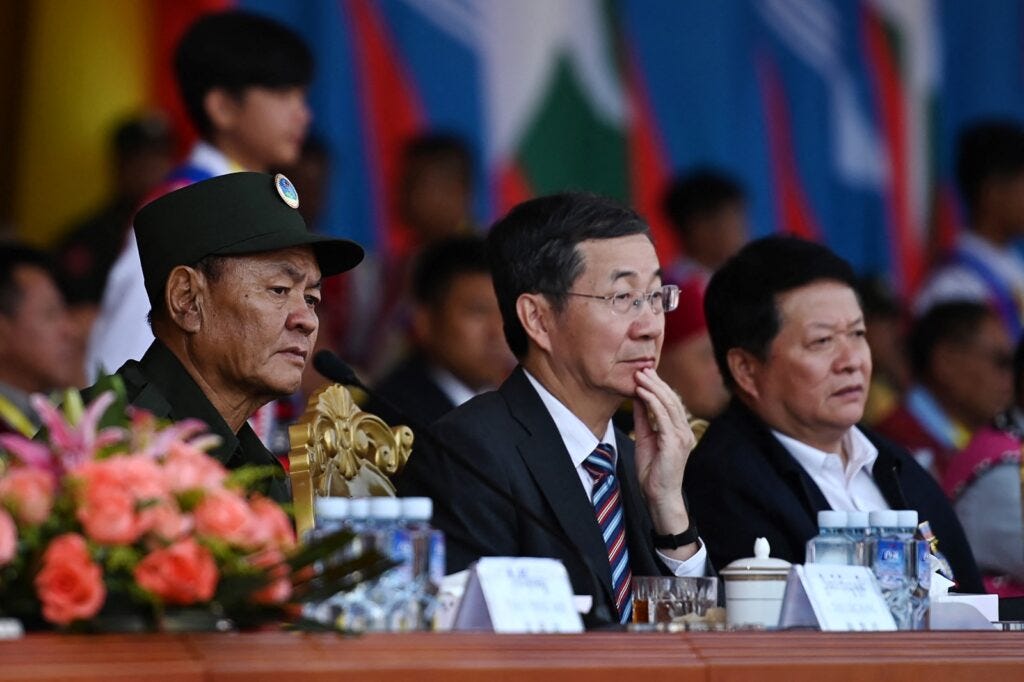
China is running what might be the world’s most elaborate balancing act on its southern border. Think of it as diplomatic plate-spinning, where every plate represents a different armed group, and dropping even one could shatter China’s carefully constructed buffer zone.
The Public Face: High Principles and Careful Words
Officially, China wraps everything it does in the principle of non-interference. It’s a brilliant piece of diplomatic cover. This allows Beijing to talk to whoever happens to be in charge (right now, that’s the military junta known as the SAC) while also maintaining back channels to ethnic armed groups. When critics raise eyebrows, China simply points to its policy: we don’t interfere, we talk to everyone.
But here’s where it gets clever. China frames all of this through concepts like “peaceful development” and the “community of shared destiny”, essentially arguing that Myanmar’s stability isn’t just Myanmar’s problem, it’s a regional concern. And who’s the biggest neighbour with the longest border? China.
Above all else, Beijing has one non-negotiable priority: border stability. This single objective justifies everything: the ceasefire negotiations, the military coordination with Myanmar’s army, the quiet conversations with rebel commanders. China presents this not as meddling but as responsible management of its own backyard. And in a way, they’re not wrong.
Dealing with the Junta: The Messy Main Channel
China’s relationship with Myanmar’s military government is a masterclass in having your cake and eating it too. Since the 2021 coup, Beijing has perfected what we might call “recognition without endorsement.”
Here’s what that looks like in practice. China continues to call Myanmar’s crisis an “internal affair”, a diplomatic code for “not our problem, stop asking us to fix it.” The United Nations, it blocks sanctions that would punish the junta. State-owned Chinese companies keep building roads, pipelines, and power plants. On paper, it looks like full support.
But look closer. China also keeps urging “inclusive dialogue” and pushing for a return to the “peace process.” That’s not empty rhetoric, it’s pressure. What Beijing is really saying to the generals is this: we’ll keep you afloat, but don’t you dare let this country completely collapse and take our investments down with it.
The leverage China holds is significant. First, there’s the diplomatic shield at the UN; without Chinese protection, the junta would face far harsher international consequences. Second, China is Myanmar’s economic lifeline, its largest trading partner and a crucial investor. Third, while carefully calibrated, China remains a potential source of military equipment.
But here’s the key: China doesn’t use this leverage to overthrow the junta. Instead, it uses it like a bridle on a horse to steer behaviour. Push for negotiations. Crack down on those scam compounds on the border that embarrass Beijing. Protect our projects. This is influence without control, pressure without regime change.
The Other Side of the Coin: Why China Courts Rebel Armies
Now we get to the part that really confuses people. Why would China maintain relationships with ethnic armed groups fighting against the government it supports? The answer reveals the sophistication of the Chinese strategy.
China’s approach to these groups is anything but uniform. It’s hierarchical, ruthlessly practical, and laser-focused on Chinese interests; not ideology, not justice, just interests.
Take the groups right on China’s border, especially the United Wa State Army (UWSA) and the Myanmar National Democratic Alliance Army (MNDAA). These aren’t just diplomatic contacts. They’re crucial security partners. The UWSA alone fields roughly 30,000 troops, making it one of the most powerful armed forces in Southeast Asia. For China, these groups serve multiple purposes: they create a stable buffer zone right across the border, they ensure no anti-China activities take root in the region, and importantly, they give Beijing influence it can use to pressure both other armed groups and the junta itself.
Put simply, when you control access to some of the most powerful non-state armies in the region, you become indispensable to everyone.
With other major groups like the Arakan Army on the coast or the Kachin Independence Army in the north, China’s engagement is more calculated and variable. The Arakan Army controls territory where China has invested heavily in port facilities at Kyaukphyu, so China facilitates talks between them and the junta. The Kachin and Karen groups? China engages them through its border proxies and includes them in peace forums held in Kunming.
Here’s what China isn’t doing, despite what some might think: it’s not using these armed groups as weapons against the military government. That’s too crude, too risky. Instead, China cultivates these relationships as strategic reserves of pressure. By keeping these channels open, Beijing sends an unmistakable signal to the junta: if you don’t address our concerns, like attacks on border towns or threats to our projects, can always let these groups operate a bit more freely. We don’t even have to actively support them; we just stop constraining them.
It’s influence through implication. And it’s remarkably effective.
When China hosts peace talks in Kunming, it’s not trying to solve Myanmar’s decades-old civil war. The goals are far more limited and instrumental: compartmentalise the conflict. Broker local ceasefires in northern Shan State. Create safe zones around critical infrastructure. Build firewalls between the fighting and Chinese interests. China has no illusions about imposing nationwide peace, and frankly, it doesn’t need to. What it needs is to protect its investments and keep its border quiet.
Infrastructure as Influence: The Projects That Bind
Chinese economic projects in Myanmar, the China-Myanmar Economic Corridor, pipelines, and dams serve a dual purpose that’s both brilliant and precarious. They’re tools of leverage and sources of vulnerability at the same time.
These projects create dependencies. The junta needs Chinese investment. Regional ethnic armies need the jobs and electricity these projects bring. Everyone becomes a stakeholder in stability, at least in theory. Chinese companies often negotiate directly with local armed groups for security and logistics, essentially paying them to have skin in the game.
But here’s the flip side: these same projects make China vulnerable. Remember the Myitsone Dam? It became such a nationalist lightning rod that it’s been suspended for over a decade. Now China can’t just deal with the government in Naypyidaw; it has to manage relationships with a mosaic of local powers, from ethnic armies to village militias to civil society groups.
Every project becomes an exercise in micro-diplomacy. And the threat of suspending investment? That’s leverage China can use on everyone, junta generals and rebel commanders alike.
The Contradictions China Lives With
Here’s where it gets really interesting. How does China square the circle of claiming neutrality while being the most important stakeholder in Myanmar’s conflicts?
The answer is elegant verbal footwork. China claims procedural neutrality, “we talk to all sides; we don’t take positions”, while being ruthlessly outcome-oriented. Its neutrality is about process, not results. And the result it wants is clear: a stable, manageable border region where its projects are safe.
China has made a calculated trade-off. It prioritises immediate border security over long-term solutions. What Beijing practices is something we might call managed instability, preventing state collapse or mass warfare on its doorstep while accepting, even tolerating, low-intensity conflict elsewhere in Myanmar. A comprehensive political settlement would be nice. Border control and project security are essential.
So, has it worked? Yes and no.
On the success side, China has largely prevented the refugee crises it fears most. Its core infrastructure, pipelines, border towns, and major projects, remain largely intact. And crucially, China has positioned itself as the one power that no side in Myanmar’s conflicts can afford to ignore. Whether you’re a general in Naypyidaw or a rebel commander in the hills, you need to think about what Beijing wants.
But there are real costs and growing risks. Many ordinary people and armed groups in Myanmar see China as an opportunistic manipulator playing all sides for its own benefit. That breeds resentment. And while China’s approach can suppress symptoms, it doesn’t heal the underlying disease. Myanmar’s conflict has roots that run deep, ethnic grievances, economic inequality, and military authoritarianism, and no amount of Chinese mediation addresses those.
Perhaps most dangerously, the strategy carries constant escalation risks. What happens if the junta launches a major offensive against a China-aligned ethnic army? What if an armed group attacks a major Chinese project? Either scenario would force Beijing into a very public, very difficult choice, and potentially expose the limits of its influence for all to see.
The Bottom Line: Strategic Pragmatism on the Periphery
Let’s be clear about what China is and isn’t in Myanmar. It’s not a neutral mediator standing above the fray. It’s also not a puppet-master controlling every move. What China is, in fact, is a calculated manager of its periphery, running a sophisticated operation designed to shape the behaviour of every armed actor toward a single goal: creating a predictable, minimally disruptive borderland.
China leverages economic power, provides diplomatic cover at the UN, and maintains deep relationships across Myanmar’s conflict spectrum, not to pick winners and losers, but to keep everyone in check. It uses its economic might to discipline the junta. It uses border ethnic armies as both stabilisers and instruments of indirect pressure. The ultimate objective isn’t to resolve Myanmar’s civil war. It’s to insulate China from the war’s consequences while extracting maximum strategic and economic benefit.
What this means for us is watching a great power accept, even prefer, a managed, fragmented status quo over the risks of either full commitment or complete withdrawal. It’s a strategy that’s tactically effective and impressively adaptive. China has proven adept at responding to Myanmar’s ever-shifting landscape.
But make no mistake: this approach remains vulnerable. Myanmar’s conflicts have a way of defying management. The next major battle, the next attack on Chinese workers, the next nationalist uprising, any of these could upend Beijing’s carefully maintained balance. China has built an impressive system for managing instability on its border. Whether that system can withstand Myanmar’s profound internal strife over the long term remains an open, and genuinely fascinating, question.
Acknowledgement: This article was edited with the assistance of Grammarly (writing assistant tool) to improve readability.